
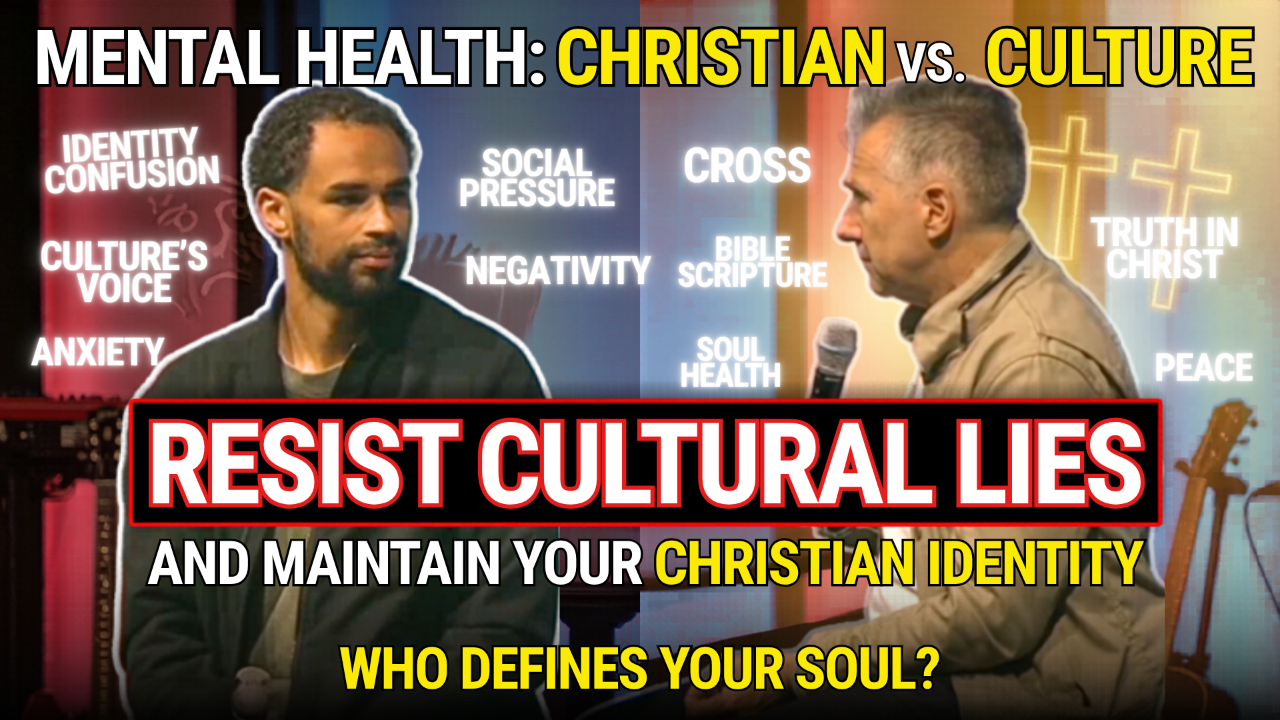
Is Mental Health a Biblical Concept? What Scripture Says About Soul Health
Quick Summary
"Mental health is a modern construct. Soul health is a biblical one. The Hebrew word nephesh never divides you into parts — it sees you as one whole person, made in the image of God, designed to be healthy from the inside out. When you start with who God is, everything else finds its proper place."
Watch the full conversation below, or keep reading for the complete teaching.
Jump to Section
Estimated reading time: 10 minutes
- Where Did Mental Health Come From?
- What the Bible Says: The Nephesh
- The Three Obstacles to Soul Health
- The Natural vs. Renewed Perspective
- Three Practical Steps Toward Soul Health
- Biblical Anchor
- How to Apply This
- FAQs
The term mental health is everywhere right now. In your social media feed, in your church, in your conversations. And while the desire behind it is real — people genuinely want to feel well — there is a question most Christians have never stopped to ask:
Is mental health actually a biblical concept?
The honest answer is no. Not in the way we use it today. Mental health as a category is a relatively modern construct — shaped more by Greek philosophy, the Enlightenment, and secular psychology than by Scripture. And when we uncritically adopt that framework, we end up treating ourselves like machines with separate compartments to fix rather than whole persons made in the image of God.
The Bible has a different word entirely. A different picture. And it is far more hopeful than anything the mental health industry has to offer.
In this post — and in the video above — we are going to look at what Scripture actually says about human wholeness, why the modern mental health framework falls short, and three practical steps toward what the Bible calls soul health.
If this resonates, you may also want to read how to renew your mind biblically and 5 daily habits that rewire your brain in Christ as companion pieces.
Where Did "Mental Health" Actually Come From?
Most people assume mental health is a timeless concept. It is not. When you trace its history, five major movements shaped the way we think about human wellbeing today — and none of them started with Scripture.
It began with Greek philosophy. Plato introduced dualism — the idea that you have a higher immaterial soul and a lower material body. That was the first major split, dividing the human person into parts. Then came the Enlightenment, which made everything about the rational mind and stripped out the supernatural. Modern science followed with specializations — psychiatry, neuroscience, trauma studies — each one breaking human beings into smaller and smaller categories. Industrialization then started treating people like machines with parts to optimize. And by the 1980s, secular psychology had made emotional comfort and self-actualization the primary goals of human life.
The result? We now have work life, family life, church life, emotional life — all spinning separately — and we wonder why nothing ever feels fully healed.
Here is the truth: you do not have fifty different lives with fifty different health bars. You have one life. One soul. And when you try to fix just one compartment while ignoring the rest, nothing actually gets better. Everything is connected because you are one integrated person.
What the Bible Actually Says: The Nephesh
The Hebrew word for soul is nephesh. And unlike the Greek dualistic picture, the nephesh encompasses the whole person. It never divides. It never separates. It looks at the totality of what it means to be a human being made in the image of God.
Christianity does not see us as disconnected parts to be optimized. It sees us as image-bearers who are formed — through our loves, our habits, our worship, our community, and our thinking — in one unified direction. You cannot separate those things. They are all one integrated life moving either toward God or away from him.
The Apostle John captured this in 3 John 1:2 when he wrote, "I pray that you may prosper and be in health, even as your soul prospers." He did not say mental health. He said soul health. The prosperity of the whole person flows from the prosperity of the soul.
This is the framework the Bible gives us. Not compartments to manage. A soul to steward. If you want to go deeper into what this kind of formation looks like practically, explore the Spiritual Growth Roadmap and take the free Spiritual Growth Assessment.
The Three Obstacles to Soul Health
Before we talk about moving forward, we need to name what holds people back. These are not comfortable to sit with, but they are necessary.
1. Wounds and Trauma
Unhealed wounds do not disappear. They act like a rubber band — you try to move forward and they snap you back. Trauma is not just what happened to you. It is what you do with what happened to you and how you process it. The Lord wants to heal your wounds. Scripture tells us to confess our sins to one another that we may be healed (James 5:16). Healing happens in community, not isolation. Bring the fullness of yourself into God's presence and allow him to do what only he can do.
2. Unforgiveness
Unforgiveness is a poison you consume while hoping someone else suffers. It robs you of the freedom and breakthrough you are desperate for. Jesus was not subtle about this. In Matthew 6:14-15 he said plainly that if you refuse to forgive others, your Father will not forgive you. This is not a minor issue. It is one of the enemy's most effective strongholds. Let go and trust God to vindicate. You get to be free.
3. Willful and Intentional Sin
This one rarely gets talked about, but it must be. You cannot walk contrary to the word of God in one area of your life and expect peace in your soul. Integrity means oneness. A double-minded person is unstable in all their ways (James 1:8). This is not about perfection — it is about direction. When you stop wrestling with sin and simply accept it, you have built a stronghold that chains you to stagnation. Everything God says in his word is for your good. When you reject it, you embrace something lesser.
Run your current season through these three honestly. If one surfaces, do not receive condemnation. Receive an invitation to do the hard work of healing with the Lord.
The Natural Perspective vs. The Renewed Perspective
Here is where the teaching gets genuinely transformational.
Most people operate from the bottom up. Past circumstances and traumas produce feelings. Those feelings generate thoughts. Those thoughts shape identity. And that distorted identity shapes their view of God — making him small, distant, or untrustworthy. When God is at the bottom of your framework, he does not have enough room to change anything above him.
The renewed perspective flips the entire picture. You start with God — his character, his attributes, his faithfulness, his power. You let that shape your identity in Christ. That identity then filters your thoughts. And those thoughts govern your feelings, rather than the other way around.
This is what the Psalms model consistently. The psalmist names the circumstance, acknowledges the feelings, reorients to truth, and ends in worship. That arc — from honest lament to God-centered declaration — is the biblical path to a stable soul.
It is also what Paul describes in Philippians 4:6-7. Bring everything to God in prayer with thanksgiving. And the peace of God, which surpasses all understanding, will guard your heart and mind in Christ Jesus. That is not a formula. That is a way of life. Explore what building this kind of identity-rooted foundation looks like through the School of Biblical Apprenticeship.
Three Practical Steps Toward Soul Health
1. Discover Who God Is
Soul health begins with a clear, biblical picture of God. Not a vague sense that he is good, but a deep, studied, meditated-on knowledge of his character and attributes. He is a good Father. He is trustworthy. He works all things for the good of those who love him. He has all authority. The winds and waves obey him. When you know that God, fear loses its grip. Start by doing a focused study of Scripture passages about who God is. Meditate on them. Let them become the lens through which you see everything else.
2. Believe Who God Says You Are
You can read Scripture and still not believe it. Knowing and believing are two different things. If you are in Christ, God sees you through the perfection of Jesus. You are adopted. You are a son or daughter of the King. That is not a motivational statement — it is a theological reality. Practice submitting to what God says about you. When intrusive thoughts come — and they will — run them through your true identity. Let truth govern your feelings, not the other way around.
3. Make Room for God
A full calendar is a spiritually dangerous thing. When your life is packed with doing, earning, achieving, and managing, you stop hearing. The space between your current activity and your actual capacity is where God speaks. This is not a call to laziness. It is a call to margin. Slow your mind. Create quiet. Let the Lord break in. As Jesus said to Martha, you are anxious and troubled about many things, but one thing is necessary. Mary chose it. Choose it.
Biblical Anchor
3 John 1:2 — "Beloved, I pray that all may go well with you and that you may be in good health, as it goes well with your soul." Soul prosperity is the foundation of whole-person health. You cannot separate them.
Psalm 46:1, 10 — "God is our refuge and strength, a very present help in trouble... Be still, and know that I am God." In the middle of chaos, the call is not to fix everything. It is to know who God is and rest in that knowledge.
Philippians 4:6-7 — "Do not be anxious about anything, but in everything by prayer and supplication with thanksgiving let your requests be made known to God. And the peace of God, which surpasses all understanding, will guard your hearts and your minds in Christ Jesus." This is the biblical prescription for soul peace — not self-management, but God-centered surrender.
How to Apply This
- Run a soul health audit. Ask yourself honestly: Are there unhealed wounds I have been avoiding? Is there someone I have not forgiven? Is there an area of willful sin I have accepted? Name it. Bring it to God.
- Start a God-character study. Spend one week reading and meditating on Scripture passages about who God is. Write down what you discover. Let it reshape your view of him from the ground up.
- Identify one place to make room. Look at your calendar this week. Where can you create 15-20 minutes of intentional quiet? Not a podcast. Not a devotional app. Just you, Scripture, and silence.
- Practice identity declaration. Each morning, speak one truth about who God says you are. Not who you feel like. Who he says you are. Do this for 30 days and watch what shifts.
- Engage the Psalms as a prayer model. Pick one Psalm this week. Follow its arc — name your circumstance, acknowledge your feelings, reorient to truth, end in worship. Let it teach you how to pray your whole soul.
Frequently Asked Questions
Q: Is mental health a biblical concept?
A: Not in the modern sense. Mental health as a category emerged from Greek philosophy, the Enlightenment, and secular psychology — not Scripture. The Bible uses the Hebrew word nephesh to describe the whole person. Biblical soul health is a more accurate and complete framework than the compartmentalized mental health model our culture uses today.
Q: What does the Bible say about soul health?
A: 3 John 1:2 connects whole-person prosperity directly to the health of the soul. The Psalms model emotional honesty before God as a path to stability. Philippians 4:6-7 offers prayer and thanksgiving as the pathway to the peace of God. Scripture consistently treats human beings as integrated wholes, not collections of separate parts.
Q: What is the Hebrew word for soul and what does it mean?
A: The Hebrew word is nephesh. It encompasses the whole person — mind, body, spirit, relationships. It never divides or separates. It is the biblical picture of what it means to be a complete human being made in the image of God. When the nephesh is healthy, the whole person is healthy.
Q: What are the biggest obstacles to soul health for Christians?
A: Based on Scripture, three major obstacles hold believers back: unhealed wounds and trauma, unforgiveness, and willful intentional sin. Each one creates a stronghold that prevents forward movement. Addressing them honestly before God — not with condemnation but with courage — is where soul health begins.
Q: How is soul health different from self-help or therapy?
A: Self-help starts with you. Therapy focuses on one dimension of your wellbeing. Soul health starts with God — his character, his word, his presence. It is not self-improvement. It is Spirit-enabled transformation rooted in who God is and who he says you are. The goal is not a better version of yourself. It is a more deeply formed apprentice of Jesus.
Q: What is top-down theology and why does it matter for mental health?
A: Top-down theology means you start with who God is and let that define everything else — your identity, your circumstances, your feelings. Bottom-up theology lets your circumstances and feelings define who God is. Most of our culture lives at the bottom. The Psalms consistently model top-down theology, and it is the foundation of a stable, healthy soul.
Q: How do I start building soul health today?
A: Start with three things: discover who God is through Scripture, learn to believe what God says about your identity in Christ, and create intentional margin in your life for his presence. These are not quick fixes. They are formation practices that build a stable soul over time. The Spiritual Growth Assessment is a great first step to understand where you are and what to focus on next.
If you want clarity on where you are spiritually and what your next step looks like, take the free Spiritual Growth Assessment. In less than three minutes you will get a personalized spiritual growth score and a clearer picture of both your strengths and your next areas of growth. It is a simple, practical first step toward the soul health you are looking for.
You are not a collection of broken parts waiting to be fixed. You are an image-bearer being formed. The God who made you sees you as whole — and he is more than capable of bringing health to every dimension of your life.
Start with him. Let that change everything else.
About Khalil Burton
Khalil Burton is a Christian spiritual growth strategist, certified coach, and founder of Growing Godly. With over a decade of ministry experience and a Master's Degree in Global Leadership specializing in Spiritual Formation, he helps believers break free from spiritual stagnation and step into intentional, deeply formed apprenticeship to Jesus. As an Advanced Certified Coach through ICF, Khalil has guided hundreds of Christians toward spiritual maturity through his proven Spiritual Growth Roadmap. His mission is to make spiritual growth simple, biblical, and practical for everyday disciples.
Connect with Khalil:
- Growing Godly Homepage
- Take the Spiritual Growth Assessment
- Book a Spiritual Clarity Call
- YouTube Channel
- Welcome to the Table Podcast
GROWING GODLY NEWSLETTER
Stay connected with news and updates!
Join our mailing list to receive the blog and actionable insights.
Don't worry, your information will not be shared.
We hate SPAM too. We will never sell your information, for any reason.